


CASE STUDY
"From Scattered Tools to One Platform: Building a Collaboration and Marketplace Hub for Independent Designers"
Home Case Studies
Case Studies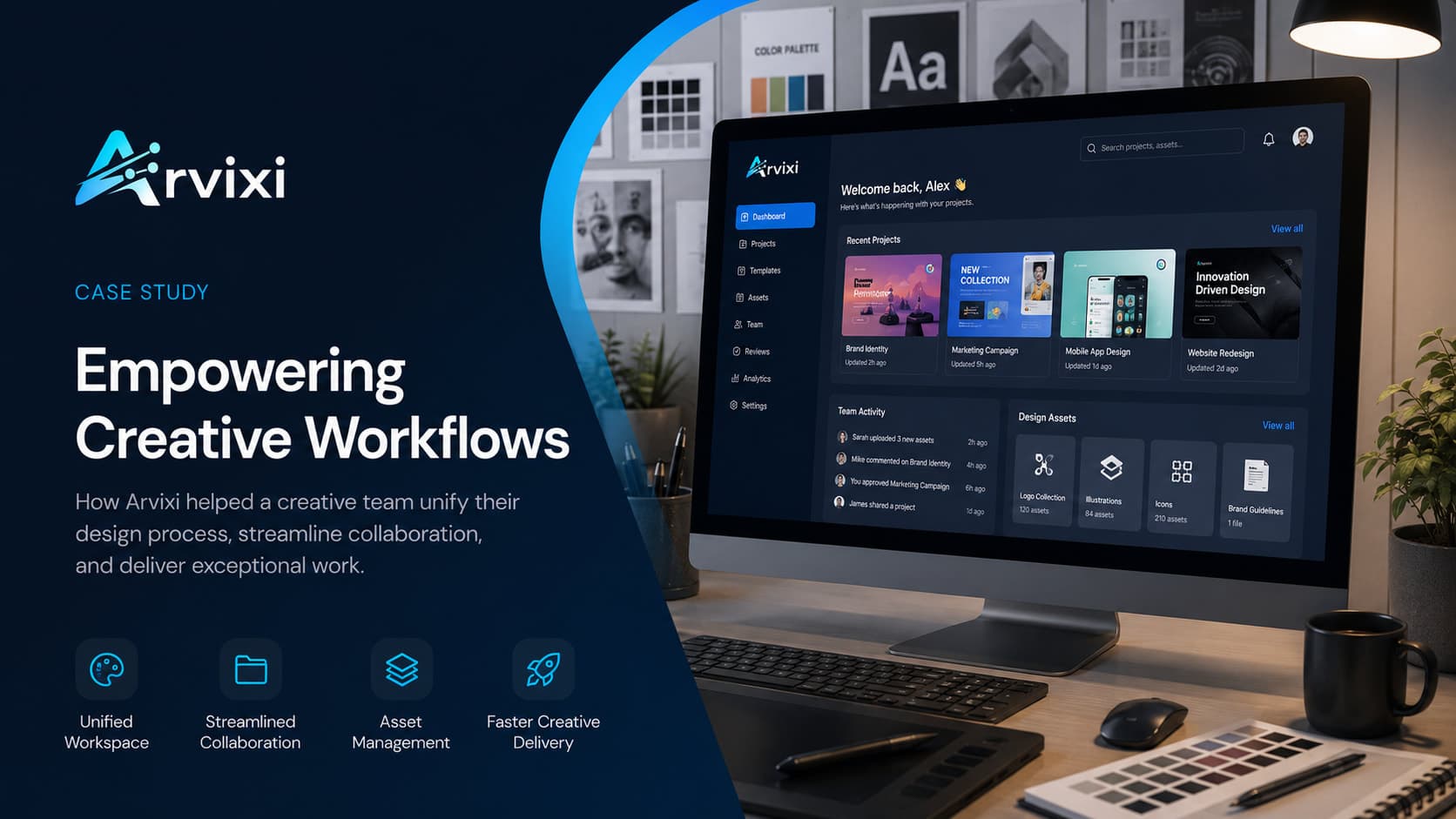
The Challenge
The client was a UAE-based startup founded by two senior brand designers who had identified a gap in how independent graphic designers manage client work and commercial relationships. The existing tool landscape forced designers to stitch together five or six separate products: cloud storage, a messaging tool, a project management tool, a separate invoicing platform, a portfolio site, and often a marketplace account.
None of these tools communicated with each other. A client revision request arrived in a message, had to be manually tracked in the project tool, required a new file upload to the storage platform, and generated a manual invoice update in the billing tool. Designers reported spending an average of 90 minutes per client project per week on tool-switching and administrative overhead that had nothing to do with actual design work.
The founding team wanted a single platform where a designer could maintain their portfolio, manage active client projects from brief to delivery, handle contracts and e-signatures, invoice and collect payment, and sell design assets directly to other designers. The platform also needed a marketplace layer where clients could browse and hire designers.
The technical challenge was non-trivial: real-time collaboration on briefs and revisions, file management capable of handling large graphic files (PSD, AI, Figma, SVG, PDF) without external cloud storage, a payment flow covering both service invoicing and marketplace transactions, and a dual-user interface presenting different views to a hiring client versus a working designer. The founding team had a clear product vision and a 340-person waitlist, but no technical co-founder and no existing codebase.
Our Solution
Arvixi delivered the platform across three product layers built on a unified backend: the Designer Workspace, the Client Portal, and the Marketplace.
The Designer Workspace covers the designer’s full commercial operation: a portfolio builder with a shareable public profile link, project management with brief intake, revision tracking with full version history, file storage purpose-built for large graphic files with preview rendering for PSD, AI, SVG, and PDF formats, in-context messaging threaded to specific projects and revisions, contract and e-signature generation, invoice creation linked to project milestones, and an earnings dashboard consolidating income from both client projects and marketplace sales.
The Client Portal gives hiring clients a clean, simplified view: browse designer portfolios, submit a project brief, review deliverables, annotate revisions directly on file previews without needing design software, approve invoices, and make payments. The client experience deliberately hides the complexity of the designer workspace.
The Marketplace is a separate product layer where designers list and sell digital assets — templates, icon sets, fonts, Figma component libraries, brand kits — with licence type selection, instant digital delivery, and a revenue-share model through the platform’s integrated payment infrastructure. The payment infrastructure supports multiple regional currencies relevant to the UAE and wider GCC market. The platform was built mobile-responsive from the start, with a separate mobile-optimised interface for client review and approval, since the founding team’s research showed approval decisions are most commonly made from a mobile device. Development ran across 22 weeks in phased delivery.
Results
• 340 waitlist designers onboarded within the first 30 days of launch
• 890 designers registered within 90 days of public launch without a paid acquisition campaign
• Designer administrative overhead reduced from 90 minutes per project per week to under 15 minutes, based on a post-launch survey of 120 active users
• 1,200 marketplace asset listings created within 60 days of the marketplace going live
• First marketplace transaction processed on day 3 of marketplace launch
• 78% of client-facing projects managed fully within the platform by day 60, with no external file-sharing or messaging tool required
• Platform processed its first $100,000 in combined service and marketplace transactions within 4 months of launch
Zero critical production incidents in the first 6 months of live operation
- Client:
Confidential - Design Collective and Marketplace Startup, UAE
- Industry:
Creative Technology / SaaS Platform
- Tags:
design platform, creative marketplace, graphic design SaaS, designer collaboration tool, portfolio platform, design asset marketplace